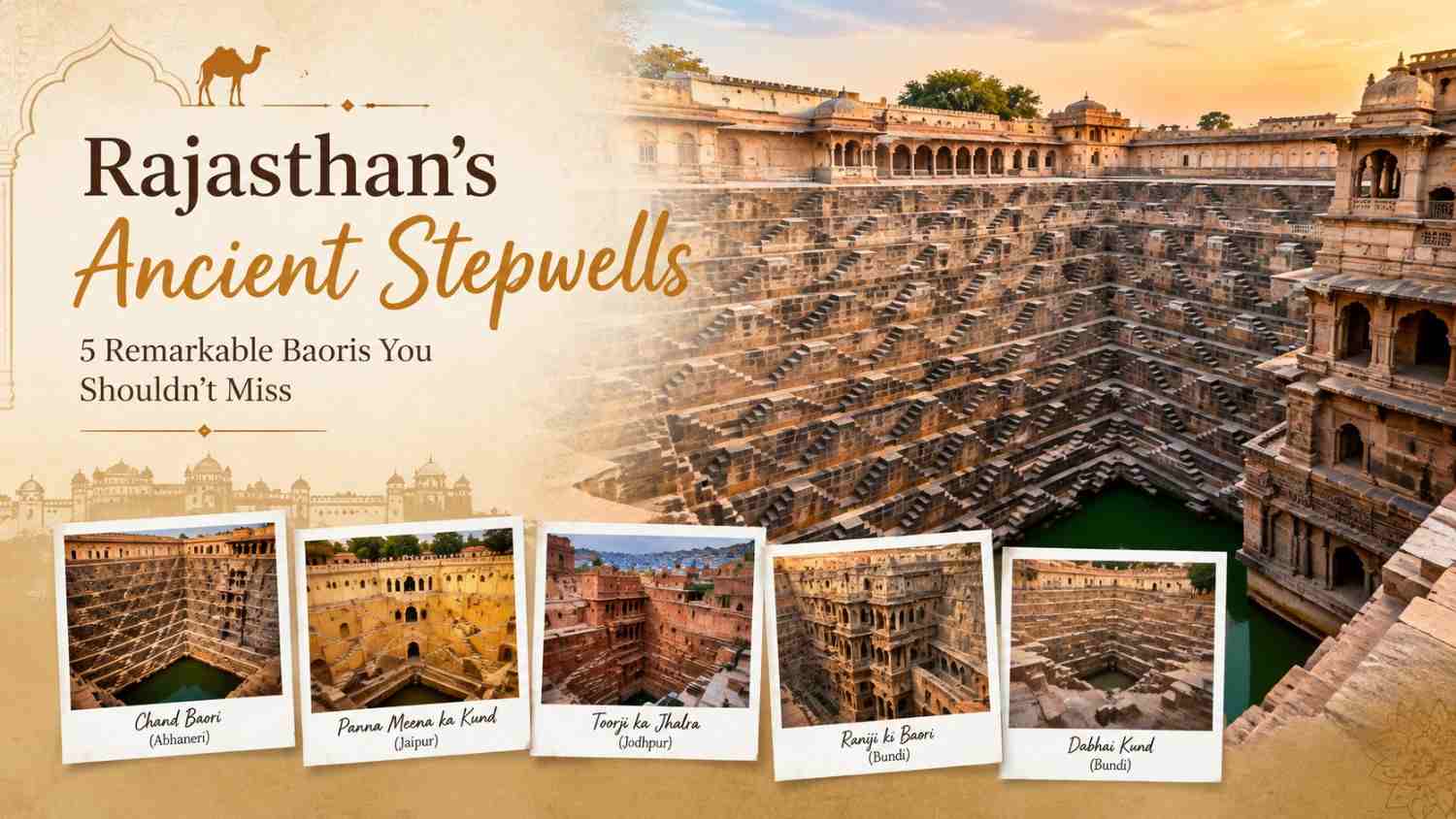
Rajasthan is famous for its magnificent forts, royal palaces and golden desert landscapes. But hidden within its historic towns are architectural wonders that tell a different story: ancient stepwells, built to collect water, provide relief from the heat and serve as gathering places for local communities.
Known as baoris, bawdis or jhalras, these structures were designed around one of Rajasthan's greatest challenges: living in a region where water has long been precious.
What makes them fascinating is how engineering and architecture came together. Geometric staircases descend deep into the earth, intricately carved pillars frame the entrances, and carefully designed corridors create striking patterns of light and shadow.
Some stepwells are easy to include in a Jaipur or Jodhpur sightseeing day. Others require a detour but reward travellers interested in history, photography and places beyond the usual tourist circuit.
If you're planning a trip to Rajasthan, here are five remarkable stepwells worth knowing about.
Add to Favorites
Location: Abhaneri village, near Dausa
Imagine standing above an enormous stone structure where thousands of narrow steps descend in perfectly repeated patterns towards a central water reservoir. That is the extraordinary sight of Chand Baori.
Built around the 9th century, Chand Baori is one of Rajasthan's most remarkable historic stepwells. Its approximately 3,500 symmetrical steps descend across multiple levels, creating a striking geometric pattern when viewed from above.
The design was practical as well as beautiful. The steps allowed people to reach the water as its level changed, while the structure provided a cooler environment during Rajasthan's intense summer heat. The more elaborately designed side includes galleries, balconies and carved architectural details.
Beside the stepwell stands the historic Harshat Mata Temple, making the visit more interesting for travellers who appreciate architecture and heritage. Read the Rajasthan Tourism guide to Chand Baori.
Chand Baori is approximately 88 km from Jaipur, according to Rajasthan Tourism. It makes a worthwhile excursion for travellers interested in historic architecture, particularly when planning a route towards Agra or exploring the Dausa region.
However, it is not a quick stop on the usual Jaipur–Jodhpur–Jaisalmer circuit. Allow time for the additional driving rather than squeezing it into an already full day of sightseeing.
Travel tip: Photograph the structure from the designated viewing areas. The repeated staircases are impressive from above, and access to restricted areas should never be assumed.
Add to Favorites
Location: Near Amer Fort, Jaipur
Not every remarkable stepwell requires a separate day trip.
Panna Meena ka Kund is tucked away near Amer Fort, one of Jaipur's most visited heritage attractions. Its striking arrangement of intersecting staircases gives the structure a beautiful geometric appearance, making it a favourite subject for architecture and travel photography.
Historically, stepwells such as this one served an essential purpose in communities where managing water was part of everyday life. Today, Panna Meena ka Kund offers visitors a glimpse into the ingenuity of traditional water architecture.
What makes it particularly appealing is how easily it fits into a Jaipur sightseeing day.
You can combine Panna Meena ka Kund with:
Amer Fort: Explore the courtyards, palace interiors and historic architecture.
Jagat Shiromani Temple: Admire the intricate stonework of this beautiful temple near Amer.
Jal Mahal: Stop for photographs of the Water Palace on Man Sagar Lake.
Jaigarh Fort: Explore the historic fortifications and enjoy panoramic views, subject to your available time.
This combination works particularly well for travellers who want to explore Jaipur beyond its famous landmarks without adding unnecessary driving.
Travel tip: Visit earlier in the day when the light is softer and the surrounding area may be quieter. Follow local access restrictions around the steps and water.
Add to Favorites
Location: Jodhpur's old city
Jodhpur is known for the imposing Mehrangarh Fort, its blue-painted houses and the narrow lanes of its old city. But among its most interesting heritage attractions is Toorji ka Jhalra, an 18th-century stepwell built during the reign of Maharaja Abhay Singh.
Associated with Queen Toorji, the structure was created as an important water source for the surrounding community. Its sandstone steps, symmetrical layout and architectural details make it a fascinating example of how historic cities managed their water needs.
The stepwell also reflects an important aspect of traditional urban life: water structures were not merely functional spaces. They could become part of the city's social and architectural identity.
Because the stepwell is situated in the old city, it can be combined with several of Jodhpur's principal attractions.
Mehrangarh Fort: Explore the palaces, courtyards and museum collections inside the magnificent fort.
Jaswant Thada: Visit the elegant white-marble memorial overlooking the surrounding landscape.
Clock Tower and Sardar Market: Experience the bustle of Jodhpur's traditional market streets.
Old-city lanes: Explore the surrounding streets, cafés and historic architecture at a relaxed pace.
Toorji ka Jhalra is particularly useful for travellers who have some flexibility in their sightseeing schedule and want to discover more than the city's best-known monuments. For background on its history, see the Incredible India guide to Toorji ka Jhalra.
Travel tip: Visit during daylight and check local access conditions. Combine the stepwell with your old-city walk rather than arranging a separate transfer just for this attraction.
Add to Favorites
Location: Bundi, Rajasthan
If you enjoy exploring places that feel different from Rajasthan's more heavily visited tourist cities, Bundi deserves your attention.
Often described as the city of stepwells, Bundi contains numerous historic baoris. Among them, Raniji ki Baori, or the Queen's Stepwell, stands out for its scale and architectural detail.
Built in 1699 by Rani Nathavati Ji, the stepwell is approximately 46 metres deep. Its multi-storey design features carved pillars, an impressive arched entrance, decorative elements and staircases descending towards the water.
The structure illustrates how water conservation, architecture and community life came together in historic Rajasthan. Stepwells were useful during dry periods and also served as gathering spaces for the people who lived nearby.
Bundi itself offers a rewarding combination of heritage architecture, quieter streets, old havelis and historic monuments. Explore the official Rajasthan Tourism information about Raniji ki Baori.
Bundi is best suited to travellers who have extra time and would like to explore a less conventional Rajasthan route.
You could combine Raniji ki Baori with Bundi Palace, Taragarh Fort and Dabhai Kund, another striking stepped water structure in the town.
However, Bundi is not directly on every classic Jaipur–Udaipur–Jodhpur–Jaisalmer itinerary. Adding it may require a route adjustment and an additional night, depending on your starting point and onward plans.
Travel tip: Consider Bundi if you enjoy heritage, photography and slower travel rather than trying to include every famous city in a short holiday.
Bundi's appeal does not end with Raniji ki Baori. Another remarkable structure is Dabhai Kund, also known as Jail Kund, which is notable for its distinctive arrangement of steps descending towards the water.
The design has an almost inverted-pyramid appearance, with successive levels creating a complex pattern of geometric lines. Viewed from above, the structure demonstrates how practical water storage could also produce an impressive piece of architecture.
Add to Favorites
For travellers who have already made the journey to Bundi, Dabhai Kund is a natural addition to the visit. Rather than rushing between distant destinations, you can spend more time understanding the heritage of one historic town.
Combine Dabhai Kund with Raniji ki Baori and other Bundi attractions. Confirm the current visiting arrangements locally, as access and conditions may vary.
If you are interested in traditional architecture, these two stepwells offer contrasting designs and make Bundi an appealing stop beyond its better-known palace and fort.
To appreciate these structures, it helps to understand the environment in which they developed.
Many parts of Rajasthan experience long dry periods and limited water availability. Communities therefore needed practical ways to collect, store and access water across changing seasons.
Stepwells provided access to water at different levels, depending on the water supply. Their descending staircases allowed people to reach the water without relying on a simple vertical well alone.
But their importance went beyond storage.
The shaded spaces and elaborate architecture could offer relief from the heat, while the surrounding structures provided places for people to gather. Some included pavilions, galleries or religious features, reflecting the cultural significance of water in everyday life.
In places such as Chand Baori, the engineering is especially striking because the repetitive staircases combine function with visual precision. In Jodhpur and Bundi, stepwells also form part of a wider heritage landscape of forts, temples, palaces and historic streets.
These structures remind us that Rajasthan's architectural story is not limited to kings and palaces. It also includes the everyday challenges that communities solved through thoughtful design.
The months from October to March are generally comfortable for exploring Rajasthan's outdoor attractions, although temperatures and conditions vary by destination.
Here are a few useful tips:
Visit in the morning: Softer light often makes the geometric patterns easier to appreciate and photograph.
Allow sufficient time: Some stepwells can be seen in a relatively short visit, while places such as Chand Baori deserve extra time to appreciate their scale.
Wear comfortable shoes: Historic surfaces and surrounding streets can be uneven.
Respect restricted areas: Do not climb barriers, enter closed sections or attempt to descend into restricted areas.
Confirm current arrangements: Opening hours, entry rules and maintenance conditions may change, so check locally before travelling.
You do not need to be an architecture enthusiast to appreciate these places. Even a short visit can reveal an entirely different side of Rajasthan.
The best way to explore these structures is to include them in a route that already makes geographical sense.
| Your itinerary | Stepwell to consider | How to include it |
|---|---|---|
| Jaipur | Panna Meena ka Kund | Combine with Amer Fort and nearby attractions |
| Jaipur and eastern Rajasthan | Chand Baori | Plan a dedicated stop towards Abhaneri and Dausa |
| Jodhpur | Toorji ka Jhalra | Combine with Mehrangarh Fort and the old city |
| Longer heritage trip | Raniji ki Baori, Bundi | Add Bundi with time for its palace, fort and other stepwells |
| Bundi heritage visit | Dabhai Kund | Combine with Raniji ki Baori |
The important thing is not to add every stepwell to a single itinerary. Some fit naturally into a sightseeing day, while others require a dedicated detour.
If you are planning a multi-city journey, our 7-day Jaipur, Jodhpur and Udaipur itinerary and 8-day Rajasthan itinerary covering Jaipur, Jodhpur and Jaisalmer can help you understand how different destinations fit together.
Chand Baori at Abhaneri is among Rajasthan's best-known stepwells. Its numerous symmetrical steps, impressive depth and distinctive geometric design make it one of the state's most remarkable historic structures.
Yes. Panna Meena ka Kund is near Amer Fort, so it can be combined with a visit to Amer and nearby attractions. Chand Baori, however, is much farther away and needs additional travel time.
For travellers interested in history, architecture and photography, Chand Baori is well worth considering. The structure is particularly impressive when viewed from above, where its repeated staircases create a striking geometric pattern.
Bundi is a good choice for travellers interested in heritage and a quieter pace. Its stepwells, palace and fort offer a different experience from Jaipur, Jodhpur and Jaisalmer. Allow extra time rather than treating it as a brief stop between distant cities.
Yes. A private itinerary can make it easier to include additional heritage stops where they fit the route. The final plan should account for driving time, sightseeing hours and your preferred pace.
Rajasthan is often remembered for its forts rising above the cities, the colours of its bazaars and the golden dunes of the Thar Desert. But its stepwells tell another story, one of water, community, craftsmanship and extraordinary architectural imagination.
From the geometric grandeur of Chand Baori to the intricate sandstone structure of Toorji ka Jhalra and the historic stepwells of Bundi, these places reveal a side of Rajasthan that many travellers overlook.
At Take A Break, we believe that a great Rajasthan holiday should be designed around more than a list of famous attractions. It should give you the opportunity to discover the places that genuinely interest you, while keeping the journey comfortable and practical.
Whether you want to explore the state's royal heritage, discover lesser-known architectural treasures or build a route around your own interests, the right itinerary can make all the difference.
Plan a customised Rajasthan journey with Take A Break, with a route designed around your travel dates, preferred destinations and pace.




Explore our highly-rated tour packages and start planning your next adventure.
View Tours Chat Now