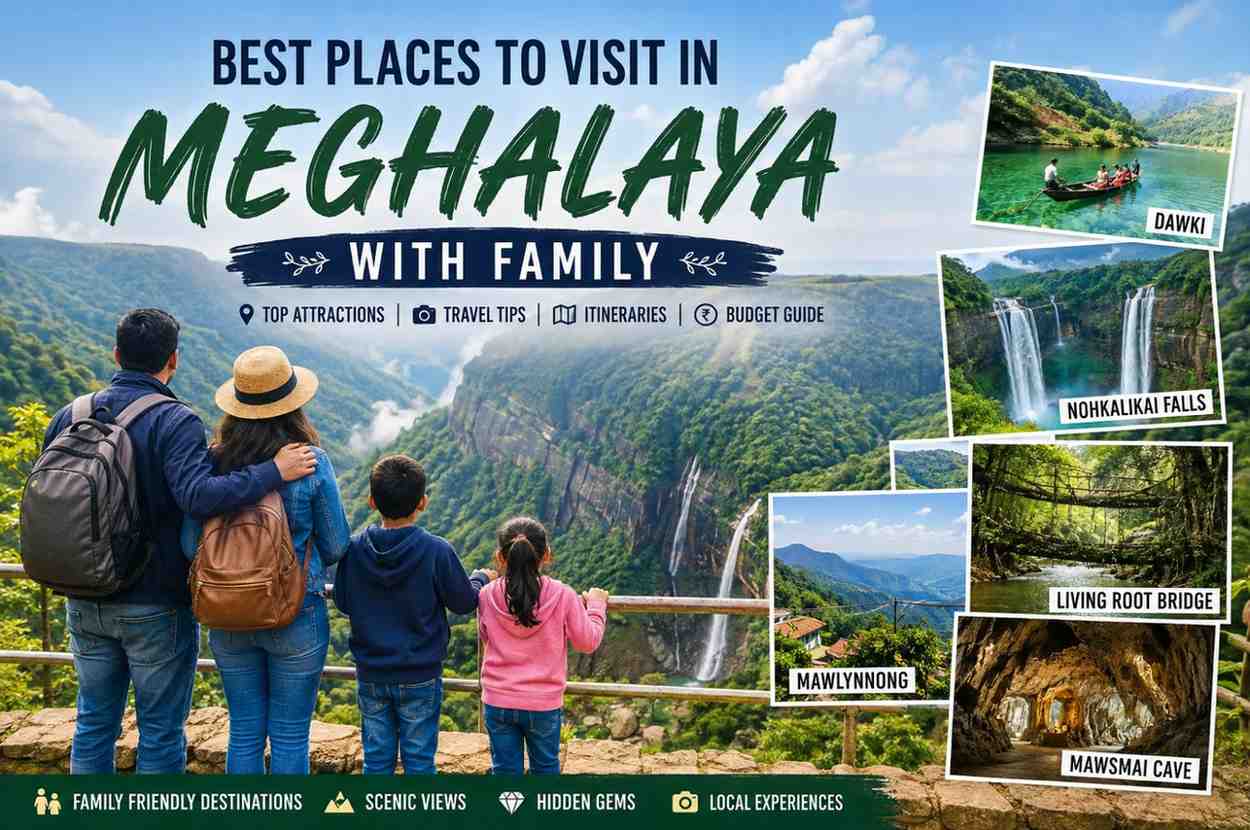
Introduction
If you're searching for Meghalaya tour packages from Hyderabad, you're probably already past the “Should I visit Meghalaya?” stage.
The real questions are more practical:
How many days do I need? How much will the trip cost? Should I fly to Guwahati? Should I stay in Shillong or Cherrapunji? Can I cover Dawki and Mawlynnong together? And is a package actually better than planning everything myself?
That's what this guide is about.
We have planned Meghalaya trips for families, couples, groups and travellers who wanted very different experiences from the same destination. And one thing we've learned is that Meghalaya is easy to underestimate on a map.
Two places may look close geographically, but the actual driving time can be considerably longer because of mountain roads, weather and traffic.
So in this guide, we're going beyond the usual list of “10 best places to visit”.
We'll look at realistic travel times, approximate costs, itinerary planning, hotels, seasons, road conditions, what is genuinely worth visiting, what you can skip, and how we'd plan the trip if we were spending our own money.
Why Meghalaya is worth visiting from Hyderabad
How to reach Meghalaya from Hyderabad
How many days do you need?
Best time to visit Meghalaya
Shillong
Cherrapunji
Dawki and the Umngot River
Mawlynnong
Meghalaya itineraries from Hyderabad
Meghalaya tour package cost
Hotels and where to stay
Transport and road travel
Meghalaya for families, couples and senior citizens
Food, shopping and local experiences
Common mistakes travellers make
Expert tips
FAQs
Final thoughts
Meghalaya works particularly well for travellers who want a holiday that feels different from the usual city-and-monument itinerary.
You get mountains, waterfalls, forests, caves, living-root bridges, small villages and some remarkably beautiful rivers — often within the same trip.
But here's the important part:
Don't try to “finish Meghalaya”.
That's one of the biggest mistakes we see when people start planning.
A seven-day itinerary that tries to squeeze Shillong, Cherrapunji, Dawki, Mawlynnong, Nongriat, Mawsynram, Laitlum and several other places together can look fantastic on paper.
On the road, it can become exhausting.
For most travellers from Hyderabad, we'd rather build a trip around 2–3 well-connected bases and give each area enough time.
| Traveller | Our view |
|---|---|
| Families with children | ⭐⭐⭐⭐⭐ |
| Couples | ⭐⭐⭐⭐⭐ |
| Honeymooners | ⭐⭐⭐⭐⭐ |
| Friends/groups | ⭐⭐⭐⭐⭐ |
| Senior citizens | ⭐⭐⭐⭐ |
| Solo travellers | ⭐⭐⭐⭐ |
| Adventure travellers | ⭐⭐⭐⭐⭐ |
For families and couples especially, Meghalaya has a useful advantage: you don't need to spend the entire holiday doing strenuous activities.
You can balance sightseeing with scenic drives, cafés, viewpoints, waterfalls and comfortable hotels.
The simplest route is usually:
Hyderabad → Guwahati → Meghalaya
Meghalaya does not have the same level of direct air connectivity as major Indian tourist destinations, so Guwahati is generally the practical gateway.
From Guwahati, Shillong is roughly a few hours by road depending on traffic, weather and the exact starting point.
And this is where I would strongly recommend not treating Google Maps' shortest route time as your itinerary.
Mountain driving isn't highway driving.
If your map says three hours, don't automatically assume you'll arrive in three hours, especially during rain or peak travel periods.
For most travellers, flying from Hyderabad to Guwahati is the sensible option.
From Guwahati, you continue by private vehicle towards Shillong.
For a customised trip, we generally prefer arranging a dedicated vehicle rather than asking travellers to figure out multiple local transfers after landing.
Why?
Because the first day of a holiday shouldn't become:
Airport → taxi negotiation → luggage loading → another taxi → hotel → figuring out tomorrow's vehicle.
You have already travelled enough.
| Stage | Approximate travel |
|---|---|
| Hyderabad → Guwahati | Flight |
| Guwahati → Shillong | Road |
| Shillong → Cherrapunji | Road |
| Cherrapunji → Dawki | Road |
| Dawki → Shillong/Guwahati | Road |
The exact driving time depends heavily on weather, traffic and your itinerary.
Image placement: Here I would generate a realistic cinematic photograph showing a private vehicle travelling through the green mountain roads of Meghalaya, with mist-covered hills, winding roads and a small amount of natural traffic.
Alt Text: Scenic mountain road from Guwahati to Meghalaya
Filename: guwahati-to-meghalaya-road-trip.webp
This is probably the most important planning decision.
For travellers coming all the way from Hyderabad, 5 nights / 6 days is a good minimum, while 6 nights / 7 days gives you a much more comfortable trip.
Here's how I'd look at it:
| Duration | Verdict | Suitable for |
|---|---|---|
| 3–4 days | Too rushed | Very limited sightseeing |
| 5 days | Possible | Shillong + Cherrapunji |
| 6 days | Good | Shillong + Cherrapunji + Dawki |
| 7 days | Ideal | First-time travellers |
| 8–10 days | Excellent | Slow travel + deeper Meghalaya |
If you're spending money on flights from Hyderabad, I wouldn't recommend travelling all that way for three rushed days.
The flight is not the expensive mistake. The expensive mistake is flying all the way to the Northeast and then spending your holiday inside a car trying to cover everything.
Meghalaya is unusual because the “best” season depends heavily on what you want to see.
If waterfalls are your priority, the rainy months can be spectacular.
If comfortable sightseeing and clearer driving conditions are more important, a drier period may suit you better.
| Season | What to expect | Our verdict |
|---|---|---|
| March–May | Pleasant, greenery, occasional rain | ⭐⭐⭐⭐ |
| June–September | Heavy rain, powerful waterfalls | ⭐⭐⭐⭐⭐ for monsoon lovers |
| October–November | Green landscapes, improving weather | ⭐⭐⭐⭐⭐ |
| December–February | Cooler and comparatively drier | ⭐⭐⭐⭐ |
One thing many travel blogs don't tell you:
Meghalaya during heavy rain and Meghalaya during dry weather can feel like two different destinations.
The waterfalls become much more dramatic during the rains, but road conditions and visibility can also become less predictable.
So don't simply ask:
“Which month is best?”
Ask:
“What kind of Meghalaya do I want to experience?”
Image placement: Generate a realistic wide-angle photograph of a Meghalaya waterfall during monsoon, with dense green vegetation, mist, wet rocks and a few travellers standing at a safe viewpoint. The image should feel like premium travel photography rather than an exaggerated fantasy landscape.
Alt Text: Meghalaya waterfall during monsoon season
Filename: meghalaya-waterfall-monsoon.webp
Shillong is usually the first major base for travellers entering Meghalaya.
And personally, I wouldn't treat Shillong as merely a place where you sleep before moving on.
Give the city some time.
The city has cafés, viewpoints, markets, churches, local food and a completely different pace from most large Indian cities.
For a first Meghalaya trip, Shillong also works well because you can recover from the journey before beginning the longer sightseeing days.
Some popular experiences include:
Shillong Peak
Elephant Falls
Ward's Lake
Police Bazaar
Laitlum Canyon
Local cafés
Cathedral of Mary Help of Christians
Don Bosco Museum
But here's where we'd be selective.
You don't need to visit every attraction simply because it appears on a Google list.
If your trip is short, I'd prioritise Laitlum, Elephant Falls and the experiences around the city, while keeping enough time for Cherrapunji and Dawki.
If Shillong is your base for getting comfortable with Meghalaya, Cherrapunji — Sohra is where the landscape really starts changing.
The drive from Shillong is scenic, but don't make the mistake of treating Cherrapunji as just a collection of waterfalls that you can tick off in one afternoon.
There is enough to see here for one full day, and preferably more if you want to explore without constantly watching the clock.
The biggest question is not “What can I see in Cherrapunji?”
It's:
“Which places are actually worth spending time on?”
Because there are plenty of viewpoints and waterfalls, and some are far more impressive than others depending on the season.
Nohkalikai Falls
Seven Sisters Falls
Mawsmai Cave
Arwah Cave
Wei Sawdong Falls
Dainthlen Falls
Eco Park
Shillong Peak route
Local viewpoints and smaller waterfalls
This is one of the places I'd keep on almost every first Meghalaya itinerary.
The viewpoint gives you a dramatic perspective of the waterfall dropping into the green valley below.
But here's something important:
The experience changes dramatically with weather.
During the rainy season, the waterfall can be much more powerful. During drier months, the volume may be considerably lower.
So don't judge the attraction purely from photographs you've seen online.
This is an interesting comparison.
Mawsmai Cave is easier and more accessible, which makes it suitable for travellers who want a quick cave experience.
Arwah Cave is more adventurous and generally feels less commercial.
If you're travelling with children or older family members, Mawsmai may be the easier choice.
If you're comfortable walking and want something more adventurous, I'd lean towards Arwah.
| Experience | Mawsmai Cave | Arwah Cave |
|---|---|---|
| Difficulty | Easier | Moderate |
| Time required | Shorter | Longer |
| Family friendly | Yes | Depends on mobility |
| Adventure | ⭐⭐⭐ | ⭐⭐⭐⭐ |
| Crowd | Can be busy | Usually quieter |
| Our choice | Convenience | Experience |
Generate this image for the blog:
A realistic premium travel photograph of Cherrapunji during the rainy season, viewed from a dramatic green cliff overlooking a powerful waterfall, dense tropical vegetation, low clouds and mist, with two or three travellers standing safely at a viewpoint. Natural colours, documentary travel photography, no exaggerated saturation.
SEO Alt Text: Cherrapunji waterfall and green valleys Meghalaya
Filename: cherrapunji-meghalaya-waterfalls.webp
Caption: Cherrapunji is best experienced slowly, especially when the monsoon brings its waterfalls to life.
If there is one photograph that has probably convinced thousands of people to visit Meghalaya, it is the famous crystal-clear Umngot River at Dawki.
And yes, it can genuinely be beautiful.
But there's a catch.
The river does not look equally crystal-clear throughout the year.
Water levels, rainfall, weather and sunlight can significantly change what you see.
This is one of those situations where social media can create unrealistic expectations.
You might arrive expecting a boat floating above a perfectly transparent river.
Instead, you may find a beautiful but much more normal-looking river.
That doesn't mean Dawki isn't worth visiting.
It means you should visit Dawki for the experience, not just for one Instagram photograph.
A boat ride is one of the most enjoyable things to do here.
The best experience depends heavily on:
Water conditions
Weather
Time of day
Crowd levels
Season
If photography is important to you, morning light can often produce a much better experience than arriving when the area is crowded.
For a first Meghalaya trip:
Yes.
But I wouldn't build the entire itinerary around Dawki.
It's best combined with other attractions in the region rather than treated as a destination that requires an entire day by itself.
Mawlynnong became extremely popular after being widely promoted as one of Asia's cleanest villages.
But today, I'd suggest visiting it for more than that label.
The village offers a glimpse into a different style of rural Meghalaya, with traditional homes, greenery and a strong community emphasis on cleanliness.
However, don't expect a giant tourist attraction.
It's a small village experience, not a theme park.
That's exactly why some travellers love it — and why others find it underwhelming.
If your idea of travel is discovering how people live, it's worthwhile.
If you're travelling with a very tight itinerary and are already covering several villages and viewpoints, you could potentially skip it.
That's the sort of decision we prefer to make based on the traveller rather than blindly adding every popular location.
Generate this image for the blog:
A highly realistic travel photograph of the Umngot River at Dawki, Meghalaya, with a traditional narrow wooden boat on calm clear green-blue water, limestone and forested hills in the background, soft morning sunlight and a few tourists naturally positioned near the riverbank. Premium documentary photography, realistic Indian Northeast landscape, no fantasy elements.
SEO Alt Text: Umngot River Dawki Meghalaya boat ride
Filename: umngot-river-dawki-meghalaya.webp
Caption: Dawki is best enjoyed for the river experience, not just the famous photograph.
For most travellers flying from Hyderabad, this is the kind of structure we'd consider a good starting point.
The exact itinerary should change according to flight timings and travel preferences.
Arrive in Guwahati and drive towards Shillong.
Don't overload this day with sightseeing.
You have already spent time travelling.
Check into the hotel, have dinner and rest.
Overnight: Shillong
Keep this day relatively relaxed.
Possible sightseeing:
Shillong Peak
Elephant Falls
Cathedral
Don Bosco Museum
Ward's Lake
Police Bazaar
If you're travelling with children or elderly family members, don't try to complete every attraction.
Overnight: Shillong
Start after breakfast.
Depending on your chosen route and attractions, you can include:
Mawkdok Dympep Valley
viewpoints
waterfalls
Nohkalikai Falls
Mawsmai Cave
Seven Sisters Falls
Overnight: Cherrapunji
Use the second day to explore the attractions you couldn't comfortably cover on Day 3.
This is also where your itinerary can become more adventurous if the group is interested.
Possible options include:
Arwah Cave
Wei Sawdong Falls
Dainthlen Falls
local viewpoints
additional waterfall stops
Overnight: Cherrapunji
This is one of the longer sightseeing days.
Start early.
Visit Mawlynnong and continue towards Dawki.
Depending on weather and road conditions, enjoy the Umngot River and boating.
Overnight: Shillong or nearby, depending on your route.
Depending on your departure flight, you can use the morning for relaxed sightseeing or local shopping before heading towards Guwahati.
Don't schedule a major attraction several hours away from the airport on departure day.
This sounds obvious.
Yet it's one of the most common itinerary mistakes we see.
Overnight: Guwahati if your flight is next morning, or depart if your flight timing allows.
Fly back to Hyderabad.
Not necessarily.
And that's the point.
A good itinerary should be based on:
Flight timings
Month of travel
Age of travellers
Physical fitness
Hotel preference
Budget
Interest in adventure
Interest in photography
Rain tolerance
Number of sightseeing stops preferred per day
For example, a couple in their twenties who enjoys trekking should not receive the same Meghalaya itinerary as a family travelling with two young children and grandparents.
The destination is the same. The correct itinerary isn't.
If you're looking for a customised Meghalaya itinerary covering Shillong, Cherrapunji and Dawki without unnecessarily aggressive driving, a private trip can make much more sense than simply choosing the longest possible sightseeing list.
This is where travellers need to be careful.
There is no single “Meghalaya package price”.
Your final cost can change considerably depending on:
Flight fares
Hotel category
Number of travellers
Vehicle type
Travel season
Number of nights
Room configuration
Activities
Pickup/drop requirements
For a package with private transfers and decent hotels, don't compare only the headline price.
Compare what is actually included.
| Cost Component | Usually Included in Package? |
|---|---|
| Hotel accommodation | Yes |
| Breakfast | Usually |
| Private vehicle | Depending on package |
| Airport transfers | Usually |
| Sightseeing | Usually |
| Driver | Usually |
| Parking/tolls | Check package |
| Flights | Often excluded |
| Lunch | Usually excluded |
| Dinner | Depends |
| Adventure activities | Usually excluded |
| Entry tickets | Often excluded |
This is important because a ₹40,000 package and a ₹50,000 package can look dramatically different until you compare inclusions line by line.
For travellers interested in Meghalaya during the rainy season, our Meghalaya Rainy Season Tour can be a useful starting point, particularly if Cherrapunji, waterfalls, Shillong and Dawki are central to the trip.
For families who want to combine Meghalaya with Assam and wildlife, the Discover Kaziranga & Meghalaya itinerary is another option worth considering.
Discover Kaziranga & Meghalaya – 7 Day Adventure
This is one of the most important hotel decisions.
Some travellers book one hotel in Shillong for the entire trip because it appears convenient.
It isn't always.
If you're doing several days around Cherrapunji, staying there for at least one or two nights can significantly reduce unnecessary driving.
| Factor | Shillong | Cherrapunji |
|---|---|---|
| City atmosphere | Better | Limited |
| Cafés/restaurants | Better | Fewer |
| Nightlife | Better | Very limited |
| Waterfalls | Further away | Excellent access |
| Nature | Excellent | Outstanding |
| Hotel choice | More | Fewer |
| Family convenience | Excellent | Good |
| Romantic stay | Good | Excellent |
| Longer sightseeing days | Less convenient | More convenient |
For a first trip:
2–3 nights Shillong + 2 nights Cherrapunji is usually a much more sensible structure than sleeping in Shillong every night.
You'll spend less time repeatedly travelling the same roads.
And that's the kind of optimisation that doesn't necessarily look impressive in an itinerary PDF — but you'll appreciate it when you're actually sitting inside the car.
Hotel selection in Meghalaya is more important than it looks.
A hotel can have excellent reviews and still be a poor choice for your particular itinerary simply because it is in the wrong location.
This is especially true when travelling between Shillong, Cherrapunji and Dawki.
If you're spending two days sightseeing around Cherrapunji but staying in Shillong every night, you're effectively adding unnecessary driving to your holiday.
If you're staying in a remote resort because the photographs look beautiful, but your family wants restaurants, cafés and easy access to the city, you may regret the decision.
So don't choose hotels only by star rating.
Choose them according to where you are going each day.
Shillong is where you'll generally find the widest choice of hotels.
It's a good place to stay if you want:
Restaurants nearby
Cafés
Shopping
Easier evening access
More hotel choices
Better connectivity
A comfortable base for the beginning and end of the trip
For families, this can be particularly convenient.
Cherrapunji has fewer hotel choices, but the location can be much more valuable.
A property with a good valley view can also make the stay itself part of the experience.
However, don't assume that every “resort” in Cherrapunji offers luxury.
Some properties are basic but have exceptional locations.
Others photograph beautifully online but may feel quite ordinary once you arrive.
Always ask for recent room photographs and confirm exactly which room category you're getting.
For a first-time traveller, we'd generally consider something like this:
| Trip Style | Shillong | Cherrapunji |
|---|---|---|
| 4 nights | 2 | 2 |
| 5 nights | 3 | 2 |
| 6 nights | 3 | 3 |
| Family trip | 3 | 2–3 |
| Honeymoon | 2–3 | 2–3 |
| Adventure-focused | 2 | 3–4 |
The exact split should depend on your sightseeing priorities.
If waterfalls, caves and nature are the main reason you're coming to Meghalaya, don't spend all your nights in Shillong simply because there are more hotels there.
For most travellers coming from Hyderabad, I'd recommend a private vehicle with a local driver.
Not because public transport doesn't exist.
It does.
But Meghalaya is much easier to experience when you aren't constantly coordinating buses, shared taxis and local transfers.
A private vehicle gives you flexibility.
You can stop when you see a viewpoint.
You can spend another 20 minutes at a waterfall.
You can change lunch plans.
You can leave earlier because rain is approaching.
And perhaps most importantly, you don't have to spend your holiday negotiating the next ride.
For two to three travellers, a sedan can often be perfectly comfortable.
For larger families or groups with substantial luggage, an SUV or larger vehicle can make more sense.
| Vehicle | Best for |
|---|---|
| Sedan | 2–3 travellers |
| SUV | 3–5 travellers |
| Larger vehicle | Families/groups |
| Shared taxi | Budget travellers |
| Self-drive | Experienced mountain drivers only |
Don't self-drive in Meghalaya unless you're genuinely comfortable driving mountain roads.
Rain, fog, narrow roads, unexpected traffic and changing road conditions can make the experience very different from driving around Hyderabad.
Your holiday is not the time to discover whether you're comfortable with mountain driving.
This deserves its own section because it can completely change how you experience the trip.
Meghalaya looks compact on the map.
The roads don't always behave that way.
A distance that looks manageable can take significantly longer than expected.
Rain can slow traffic.
Fog can reduce visibility.
Roadwork can cause delays.
And if you stop frequently for photographs — which you probably will — the journey becomes even longer.
That's not necessarily a bad thing.
The road itself is part of the Meghalaya experience.
But your itinerary needs to respect it.
This is one of the biggest itinerary mistakes we see.
A travel plan saying:
Shillong → Cherrapunji → five waterfalls → cave → viewpoint → Dawki
may look exciting.
In reality, you'll probably spend more time looking at the clock than looking at Meghalaya.
Three good experiences are better than eight rushed ones.
Meghalaya can be an excellent family destination.
But family travel requires a little more planning than a couple's trip.
Children may enjoy waterfalls, caves, rivers and scenic drives, but long road journeys can become tiring.
I'd avoid making every day an early-morning departure.
Build in some flexibility.
Choose hotels with comfortable rooms and decent food options.
And don't underestimate the importance of washroom stops.
Mountain sightseeing doesn't always provide the same convenient facilities you'd expect in a major city.
This is where Meghalaya becomes particularly fun.
You can include:
Boating
Caves
Waterfalls
Viewpoints
Short walks
Local food
Photography
Village experiences
Teenagers also tend to appreciate having some freedom rather than spending every day at conventional tourist attractions.
This needs more honesty than most travel blogs provide.
Meghalaya is possible with senior citizens, but not every Meghalaya experience is suitable for every senior traveller.
Some attractions involve:
Uneven terrain
Steps
Slippery surfaces
Long walks
Cave exploration
Steep sections
The famous Double Decker Living Root Bridge trek, for example, is not something I'd automatically add to a senior-friendly itinerary.
It's beautiful.
But beautiful doesn't mean easy.
If mobility is limited, there are plenty of other ways to enjoy Meghalaya without turning the holiday into an endurance test.
Prioritise:
Comfortable hotels
Shorter sightseeing days
Scenic viewpoints
Waterfalls accessible from viewpoints
Private vehicle
Frequent breaks
Fewer hotel changes
And don't feel guilty about skipping an attraction.
A comfortable holiday is more valuable than an impressive itinerary PDF.
Meghalaya works surprisingly well for couples.
But I'd avoid making the itinerary too aggressive.
A honeymoon isn't a military operation.
You don't need to wake up at 5 AM every morning to prove you've seen enough.
For couples, I'd give more importance to:
Scenic hotels
Valley views
Private transfers
Sunset viewpoints
Cafés
Slow mornings
Fewer but better experiences
Cherrapunji can be particularly good for couples because the landscape and weather create a naturally romantic atmosphere.
A good hotel with a view can sometimes be more memorable than another sightseeing stop.
If you're expecting the food scene to be identical to what you find in Hyderabad, you'll need to adjust expectations.
Meghalaya has its own food culture, and trying local dishes is part of the experience.
Travellers can find local Khasi dishes alongside Indian, Chinese and café-style food.
For travellers who prefer familiar vegetarian food, Shillong generally gives you more choice than smaller towns.
If your group has very specific dietary requirements, don't wait until you're hungry and then start looking for food.
Plan ahead.
This becomes particularly important on sightseeing days around smaller towns and rural areas.
This is another practical detail people tend to discover only after reaching Meghalaya.
Network coverage varies depending on your location.
Shillong is considerably easier for connectivity.
Remote areas can be less predictable.
If you're travelling for work and absolutely need uninterrupted internet, don't assume you'll have perfect connectivity everywhere.
Download:
Offline Google Maps
Hotel details
Driver contact
Booking confirmations
Flight tickets
Important phone numbers
Take screenshots of anything important.
It takes two minutes.
It can save you a lot of frustration later.
Digital payments are widely used in India, but I would still recommend carrying some cash when travelling through Meghalaya.
You don't need to carry a huge amount.
Just don't rely entirely on your phone.
A practical approach is:
Cards + UPI + some emergency cash.
Keep the emergency cash separately from your main wallet.
For smaller villages and remote areas, payment options may be less predictable than in Shillong.
Your packing list should depend heavily on the month you're travelling.
But there are a few things I'd almost always recommend.
| Item | Why |
|---|---|
| Lightweight rain jacket | Sudden rain |
| Comfortable walking shoes | Uneven terrain |
| Extra socks | Wet conditions |
| Small umbrella | Useful for short walks |
| Power bank | Long sightseeing days |
| Waterproof phone pouch | Waterfalls/rain |
| Small backpack | Day sightseeing |
| Basic medicines | Convenience |
| Quick-dry clothes | Humid/rainy weather |
| Offline maps | Connectivity gaps |
Travellers pack only fashionable clothes because they are thinking about photographs.
Then they discover that their shoes aren't comfortable enough for the actual terrain.
Bring the good-looking clothes.
But bring good walking shoes first.
You'll thank yourself later.
Here's our honest list.
You cannot “win” Meghalaya by visiting 25 attractions.
Mountain roads are different.
Location and recent reviews matter.
Rainfall changes everything.
Leave a buffer.
Some experiences involve slippery or uneven surfaces.
The famous crystal-clear river, dramatic waterfalls and misty viewpoints depend on real-world conditions.
Especially during heavy monsoon periods.
If I were planning a Meghalaya trip from Hyderabad for my own family, I'd start with only four questions:
1. Who is travelling?
Couple? Kids? Parents? Friends?
2. What matters most?
Waterfalls? Adventure? Relaxation? Photography? Food? Nature?
3. How much driving are we comfortable with?
This dramatically changes the itinerary.
4. What is our realistic budget?
Once those four things are clear, the itinerary becomes much easier to build.
That's also why we don't believe in giving every traveller the same “standard Meghalaya package”.
The standard itinerary is a starting point.
The actual holiday should be built around the people travelling.
If your dates, hotel preferences, number of travellers or sightseeing priorities are different from a standard itinerary, a customised trip can make more sense.
At Take a Break Holidays, we can build the itinerary around your preferred pace, accommodation level and experiences rather than simply adding as many attractions as possible.
For travellers who want to combine Kaziranga with Meghalaya, our 7-day option is also worth considering:
Discover Kaziranga & Meghalaya – 7 Day Adventure
This is probably the question most travellers want answered before anything else.
And the honest answer is: there isn't one fixed Meghalaya trip cost from Hyderabad.
Two couples can travel to Meghalaya for the same number of days and end up spending very different amounts because their hotels, flights, vehicle, food and activities are different.
For a comfortable private trip, I'd look at the budget in layers rather than searching for one “average package price”.
| Expense | Budget Trip | Comfortable Trip | Premium Trip |
|---|---|---|---|
| Return flights | ₹8,000–₹18,000 pp | ₹12,000–₹25,000 pp | ₹20,000+ pp |
| Hotels | Budget | 3–4 star | Premium/boutique |
| Vehicle | Shared/private basic | Private sedan/SUV | Premium vehicle |
| Food | ₹500–₹900 pp/day | ₹800–₹1,500 pp/day | ₹1,500+ pp/day |
| Activities | Limited | Selected | More extensive |
| Approx. total* | ₹30,000–₹45,000 pp | ₹45,000–₹65,000 pp | ₹65,000+ pp |
*These are planning ranges, not fixed package prices. Flight prices and hotel rates can change significantly by date and demand.
For a family or private group, the per-person cost can also come down because the vehicle and some other costs are shared.
This is where travellers often assume that DIY travel will automatically be cheaper.
Sometimes it is.
Sometimes it isn't.
If you're travelling as a couple and are comfortable researching hotels, taxis, routes, transfers and activities yourself, independent travel can work well.
But once you add multiple travellers, different hotels, airport transfers and private sightseeing, the difference becomes less straightforward.
| Factor | DIY | Customised Package |
|---|---|---|
| Research | You handle everything | Handled for you |
| Hotel selection | Your responsibility | Suggested/booked |
| Vehicle | Arrange separately | Coordinated |
| Driver | Find yourself | Organised |
| Route planning | You plan | Planned around travel time |
| Problems during trip | You solve | Support available |
| Flexibility | High | High if customised |
| Lowest possible price | Potentially better | Not always |
| Convenience | Lower | Higher |
The important thing is not whether a package is cheaper by ₹2,000.
The important question is:
What are you getting for the money?
Not every part of your Meghalaya holiday deserves the same budget.
If I had a fixed budget, I'd prioritise it in this order:
A hotel in the right location can save hours of unnecessary driving.
You'll spend a meaningful amount of time on the road.
Don't treat the vehicle as an afterthought.
You don't necessarily need luxury.
But cleanliness, comfort, location and recent reviews matter.
This costs nothing extra but can make a huge difference.
Spend selectively on activities you'll genuinely enjoy rather than collecting them.
There are also places where spending more doesn't necessarily improve your holiday.
Extremely expensive hotels
Overpriced tourist restaurants
Too many paid activities
Unnecessary room upgrades
Multiple hotel changes
Private experiences you aren't interested in
A ₹12,000 hotel isn't automatically twice as enjoyable as a ₹6,000 hotel.
But a hotel that saves you two hours of daily driving can absolutely be worth paying more for.
That's the distinction.
Instead of obsessing over hotel stars, think about what you're actually buying.
Good for travellers who primarily need a clean place to sleep.
Don't expect luxury facilities.
Usually the sweet spot for families and couples.
You get better rooms, more reliable service and generally better comfort without paying premium-resort prices.
Worth considering when the hotel itself is part of your holiday.
Especially around Cherrapunji, a beautiful location or valley view can make the extra cost worthwhile.
This is where I'd spend more time researching.
Ask:
Is the room category actually the one shown in photographs?
Does the room have heating?
Is hot water available reliably?
Is the restaurant open during your stay?
Is the property accessible by normal vehicles?
Is there parking?
How far is it from your planned sightseeing?
Are recent reviews positive?
Does the room actually have the view you're expecting?
A “valley view” mentioned in a hotel description doesn't necessarily mean you're going to wake up to an uninterrupted panoramic landscape.
Ask for the exact room.
Food costs in Meghalaya don't have to be excessive.
A normal day can be quite reasonable if you eat at local restaurants rather than premium tourist properties for every meal.
| Traveller Type | Food Budget Per Person/Day |
|---|---|
| Budget | ₹400–₹700 |
| Comfortable | ₹800–₹1,500 |
| Premium | ₹1,500–₹2,500+ |
These are planning figures rather than fixed prices.
Restaurants in Shillong give you considerably more choice than smaller sightseeing areas.
On long sightseeing days, don't wait until everyone is starving before looking for lunch.
That's how travellers end up paying more for whatever happens to be available.
Meghalaya has plenty of experiences that don't require a large additional budget.
You don't need to buy an activity at every stop.
Umngot River boating
Worth doing when weather and water conditions are favourable.
Cave exploration
Worth it if your group enjoys walking and adventure.
Waterfall visits
Often the experience itself is the attraction; there is no need to turn everything into a paid activity.
Local village experiences
Worth considering if you want something beyond conventional sightseeing.
This deserves to be said.
Travel has developed an unfortunate habit of turning every viewpoint into a paid experience.
Sometimes the best part of Meghalaya is simply pulling over safely, looking at the landscape and spending ten quiet minutes there.
You don't need a drone shot of yourself standing on every cliff.
You need to actually enjoy the place.
This depends completely on what you want.
There is no universally “best” month.
| Season | Landscape | Rain | Crowds | Best For |
|---|---|---|---|---|
| Monsoon | Extremely green | Heavy | Moderate–high | Waterfalls |
| Post-monsoon | Green | Lower | Moderate | Balanced trips |
| Winter | Pleasant/cool | Lower | Higher around holidays | Families, sightseeing |
| Spring | Green and comfortable | Variable | Moderate | General travel |
| Summer | Pleasant compared with hotter regions | Variable | Moderate | Escaping heat |
If your priority is massive waterfalls and dramatic greenery, the rainy season is hard to beat.
If your priority is comfortable sightseeing with fewer weather disruptions, a drier period may suit you better.
Yes.
But only if you understand what you're signing up for.
Heavy rain can mean:
Beautiful waterfalls
Misty landscapes
Very green surroundings
Slippery paths
Delayed travel
Road disruptions
Reduced visibility
Changes to outdoor activities
This is why monsoon Meghalaya can be spectacular and inconvenient at the same time.
Both statements can be true.
If you are travelling with very young children, elderly family members or someone who strongly dislikes rain, I'd consider a more moderate season.
Winter is easier for many first-time visitors.
The weather is generally more comfortable for sightseeing, visibility can be better, and outdoor activities are easier to plan.
But popular periods can also mean higher demand.
If your travel dates are flexible, compare hotel and flight prices across several weeks rather than assuming one specific month is automatically cheapest.
If you're flying from Hyderabad, I wouldn't recommend trying to do Meghalaya in three or four nights unless you have no alternative.
Remember that your first and last days involve airport transfers and intercity travel.
| Duration | Verdict |
|---|---|
| 3–4 nights | Too rushed |
| 5 nights | Possible |
| 6 nights | Good |
| 7 nights | Excellent |
| 8–10 nights | Ideal for slower exploration |
For most first-time travellers from Hyderabad, 6–7 nights is the sweet spot.
It gives you enough time for Shillong, Cherrapunji and Dawki without turning every day into a road trip.
Always check inclusions.
A cheap flight at an inconvenient time can make the first and last day almost useless.
Cheap isn't necessarily bad.
But poor location and poor comfort can cost you more in frustration.
Hotel prices can rise significantly during popular travel periods.
Keep some extra money for unexpected transport, food, weather-related changes or medical needs.
This is one of the simplest ways to avoid unpleasant surprises.
Ask these questions:
Is the vehicle private?
Is the driver experienced with Meghalaya routes?
Are tolls and parking included?
Are sightseeing transfers included?
Are hotel taxes included?
What exactly is the room category?
Are meals included?
Are activities included?
Are entry fees included?
What happens if weather disrupts the itinerary?
Is airport pickup included?
What happens if the flight is delayed?
Is there someone available during the trip if something goes wrong?
A professional operator shouldn't be irritated by these questions.
You should be asking them.
It's planning the route properly.
If your hotel is badly located and your itinerary repeatedly crosses the same roads, you'll spend more time and fuel moving around.
If your route is logically designed, you can often see more while driving less.
That's why itinerary planning is not just about deciding what places to visit.
It's about deciding what order to visit them in.
And honestly, that's one of the areas where an experienced local operator can add real value.
If you don't want to build everything from scratch, Take a Break Holidays' Meghalaya Rainy Season Tour can be used as a starting point for travellers interested in Shillong, Cherrapunji, waterfalls and Dawki.
The important point is that a package doesn't have to be treated as a rigid template.
For a private customised trip, the itinerary can be adjusted around your dates, hotel preferences, pace and interests.
If we were planning this trip for our own family, we'd keep the itinerary relatively simple.
The temptation is always to add one more waterfall, one more viewpoint and one more village.
We've found that this usually makes the holiday worse, not better.
For a first visit, we'd structure it around Shillong + Cherrapunji + Dawki, with enough flexibility to account for weather and road conditions.
| Day | Plan | Overnight |
|---|---|---|
| Day 1 | Hyderabad → Guwahati → Shillong | Shillong |
| Day 2 | Shillong sightseeing | Shillong |
| Day 3 | Shillong → Cherrapunji + sightseeing | Cherrapunji |
| Day 4 | Cherrapunji sightseeing | Cherrapunji |
| Day 5 | Cherrapunji → Mawlynnong → Dawki | Shillong / nearby |
| Day 6 | Shillong → Guwahati | Guwahati |
| Day 7 | Departure | — |
This isn't the only way to do Meghalaya.
It's simply a comfortable starting framework that doesn't try to turn every day into a checklist.
If you gave us only one week and asked us to remove anything unnecessary, this is roughly how we'd prioritise the trip.
Cherrapunji / Sohra
The landscape alone makes it worthwhile.
Nohkalikai Falls
Particularly impressive when water levels are high.
Dawki / Umngot River
Worth experiencing, especially when conditions are good.
Shillong
Give the city some time instead of treating it purely as a transit point.
Mawsmai Cave
Good for a relatively accessible cave experience.
Laitlum Canyon
Excellent if your group enjoys viewpoints and landscapes.
Mawlynnong
Worth it if you enjoy village experiences.
Elephant Falls
Easy to include around Shillong.
Arwah Cave
Great for people who enjoy walking and exploration.
Double Decker Living Root Bridge
Amazing experience, but physically demanding.
Additional waterfalls
Worth adding if you're travelling during the rainy season and genuinely enjoy waterfalls.
This may be controversial, but that's okay.
If you have only five or six days, we'd rather skip a few attractions than rush through everything.
We would not automatically add every attraction appearing on a “Top 20 Meghalaya Places” list.
If something requires a long detour but doesn't fit your interests, leave it out.
You don't get bonus points for returning home with 73 sightseeing locations on your itinerary.
You get a better holiday by actually enjoying the 10–12 places you did visit.
This is one of Meghalaya's most famous experiences.
And yes, it can be incredible.
But the trek is demanding.
There are a large number of steps, uneven terrain and sections that can become slippery.
Fit travellers
Adventure lovers
Couples who enjoy trekking
Older children/teenagers
People comfortable with long walks
Elderly travellers
Very young children
People with mobility issues
Travellers uncomfortable with steep terrain
Don't choose it simply because everyone on Instagram seems to have done it.
Choose it because your group can actually enjoy the trek.
Meghalaya is generally a welcoming destination for tourists, but normal travel precautions still apply.
Follow local instructions near waterfalls.
Don't cross safety barriers for photographs.
Be careful around wet rocks.
Avoid swimming in unfamiliar water bodies.
Keep valuables secure.
Don't wander into isolated areas after dark.
Keep emergency contacts saved offline.
During heavy rainfall, conditions can change quickly.
If your driver or local guide advises against a particular route or activity because of weather, listen to them.
A photograph is never worth taking an unnecessary risk.
This is particularly important during the monsoon.
A waterfall visit may be affected by heavy rain.
A road may become slower.
Visibility may drop.
An outdoor activity may need to be postponed.
This is why we recommend keeping some flexibility in your itinerary.
A good tour operator shouldn't promise that every attraction will happen exactly at 11:30 AM regardless of what the weather is doing.
Sometimes the smartest travel decision is:
“Let's do this tomorrow instead.”
Here's the practical checklist we'd give our own travellers.
Lightweight clothes
One warm layer
Rain jacket
Quick-dry trousers
Extra socks
Comfortable walking shoes
Power bank
Charging cables
Phone
Camera
Waterproof phone pouch
Flight tickets
Hotel confirmations
Government ID
Travel insurance details
Emergency contacts
Carry any regular medicines you personally need.
Also consider keeping:
Basic pain relief
Motion-sickness medication if required
Band-aids
Basic first-aid supplies
If you take prescription medication, carry enough for the entire trip rather than assuming you can easily replace it during sightseeing.
Meghalaya is ridiculously photogenic.
But good photographs aren't only about having an expensive camera.
Shoot early when possible.
Cloudy weather can actually work beautifully because it reduces harsh highlights.
Light matters enormously.
The famous clear-water effect looks very different depending on sunlight and water conditions.
Don't photograph everything from inside the car.
Get out.
Walk a little.
Look around.
And sometimes the best photograph is the one you didn't plan.
Generate for the blog:
A cinematic but realistic wide landscape of Meghalaya showing layered green hills disappearing into soft morning mist, a winding mountain road in the foreground and a small private tourist vehicle travelling through the landscape. Natural Northeast Indian environment, premium travel photography, realistic colours, soft atmospheric light, no oversaturated greens, no fantasy appearance.
Alt Text: Scenic Meghalaya mountain landscape and winding road
Filename: meghalaya-scenic-landscape-road.webp
Caption: In Meghalaya, the journey between destinations can be just as memorable as the destination itself.
Here's a quick checklist you can save before travelling.
| Item | Essential? |
|---|---|
| Comfortable shoes | ✅ |
| Rain jacket | ✅ |
| Umbrella | Recommended |
| Power bank | ✅ |
| Waterproof phone cover | Recommended |
| Small backpack | ✅ |
| Medicines | ✅ |
| ID documents | ✅ |
| Offline maps | Recommended |
| Cash | Recommended |
| Warm layer | ✅ |
| Extra socks | ✅ |
It depends on your travel dates, flights, hotel category, number of travellers, vehicle type and activities. A comfortable private trip can often fall somewhere around ₹45,000–₹65,000 per person including major land arrangements and flights, but this is only a planning range.
We recommend around 6–7 nights for a first trip. This allows enough time for Shillong, Cherrapunji and Dawki without making every day excessively hectic.
Flying from Hyderabad to Guwahati and then travelling by road to Meghalaya is generally the most practical option.
Yes. Meghalaya can be excellent for families, provided the itinerary is designed around the children's ages and the family's physical comfort.
Yes, but the itinerary should avoid strenuous treks and excessive driving. Attractions involving steep steps and long walks should be assessed individually.
Absolutely. Couples can combine scenic hotels, Cherrapunji, waterfalls, viewpoints and relaxed sightseeing for a very good honeymoon experience.
Neither is universally better. Shillong offers better city facilities and hotel choice, while Cherrapunji is better positioned for waterfalls, caves and dramatic landscapes. For a first trip, staying in both is usually better.
Yes, particularly for the Umngot River and boating. However, don't expect the river to look identical to every photograph you've seen online. Water and weather conditions matter.
Meghalaya is generally considered a welcoming destination for travellers. As with any trip, follow local advice, take care around waterfalls and avoid unnecessary risks in poor weather.
Yes. Monsoon is actually an excellent time if waterfalls and lush landscapes are your priority. But expect heavy rain and possible changes to driving conditions.
It doesn't have to be. Accommodation and food are available across different budgets. Private vehicles and better hotels are the areas where costs can increase substantially.
For most first-time travellers, we'd recommend it. It gives you much more flexibility and removes the hassle of arranging multiple local transfers.
For two or three travellers with reasonable luggage, a sedan can usually work well. Larger groups may prefer an SUV or larger vehicle.
The road journey is generally a few hours, but actual travel time depends on traffic, weather and road conditions.
Yes, but it will be relatively fast-paced. If possible, we'd add another one or two nights.
No. The trek requires considerable physical effort and involves many steps. It isn't suitable for every traveller.
Comfortable clothes, good walking shoes and a rain jacket are the safest choices. Carry a warm layer even if you're travelling during warmer months.
No. Connectivity can become less reliable in remote areas. Download offline maps and keep important information available offline.
I'd recommend carrying some emergency cash even if you primarily use UPI or cards.
Both can work. Independent planning gives you maximum control, while a customised package can save considerable effort with hotels, vehicles, routing and local coordination.
Meghalaya rewards slow travel.
If waterfalls and caves are important to you, staying there can save considerable driving.
Especially during the monsoon.
The distances aren't always the problem. The terrain and conditions are.
A beautiful hotel in the wrong place can become inconvenient very quickly.
The actual experience is bigger than one photograph.
This sounds boring until you're standing beside a slippery waterfall in completely unsuitable footwear.
It's more than just the place where you sleep.
Leave room for doing absolutely nothing for an afternoon.
Don't automatically build the trip around what travel blogs say they “must” see.
Yes — but only if you plan it properly.
The biggest mistake would be looking at Meghalaya as another destination where you simply collect tourist attractions.
It isn't.
The roads, weather, landscapes, villages, waterfalls and changing light are part of the experience.
For someone travelling from Hyderabad, we'd recommend giving yourself enough time to make the long journey worthwhile.
Six to seven nights is a good starting point.
Build the trip around Shillong, Cherrapunji and Dawki, then add experiences according to the people travelling.
If you're travelling with family, prioritise comfort.
If you're travelling as a couple, slow down.
If you're travelling with friends, add adventure.
And if you're travelling during the monsoon, embrace the rain rather than treating it as an inconvenience.
Because that's when Meghalaya can look completely different.
There is no reason your itinerary has to look exactly like somebody else's.
Your travel dates, budget, hotel preferences, flight timings, children's ages, physical comfort and interests should determine the trip.
If you'd like a customised Meghalaya itinerary based on your dates, budget and preferences, our team at Take a Break Holidays will be happy to help you plan one.
For travellers who want to combine Meghalaya with Assam and Kaziranga, you can also explore:
Discover Kaziranga & Meghalaya – 7 Day Adventure
And if waterfalls, Cherrapunji and monsoon landscapes are your priority:


Explore our highly-rated tour packages and start planning your next adventure.
View Tours Chat Now