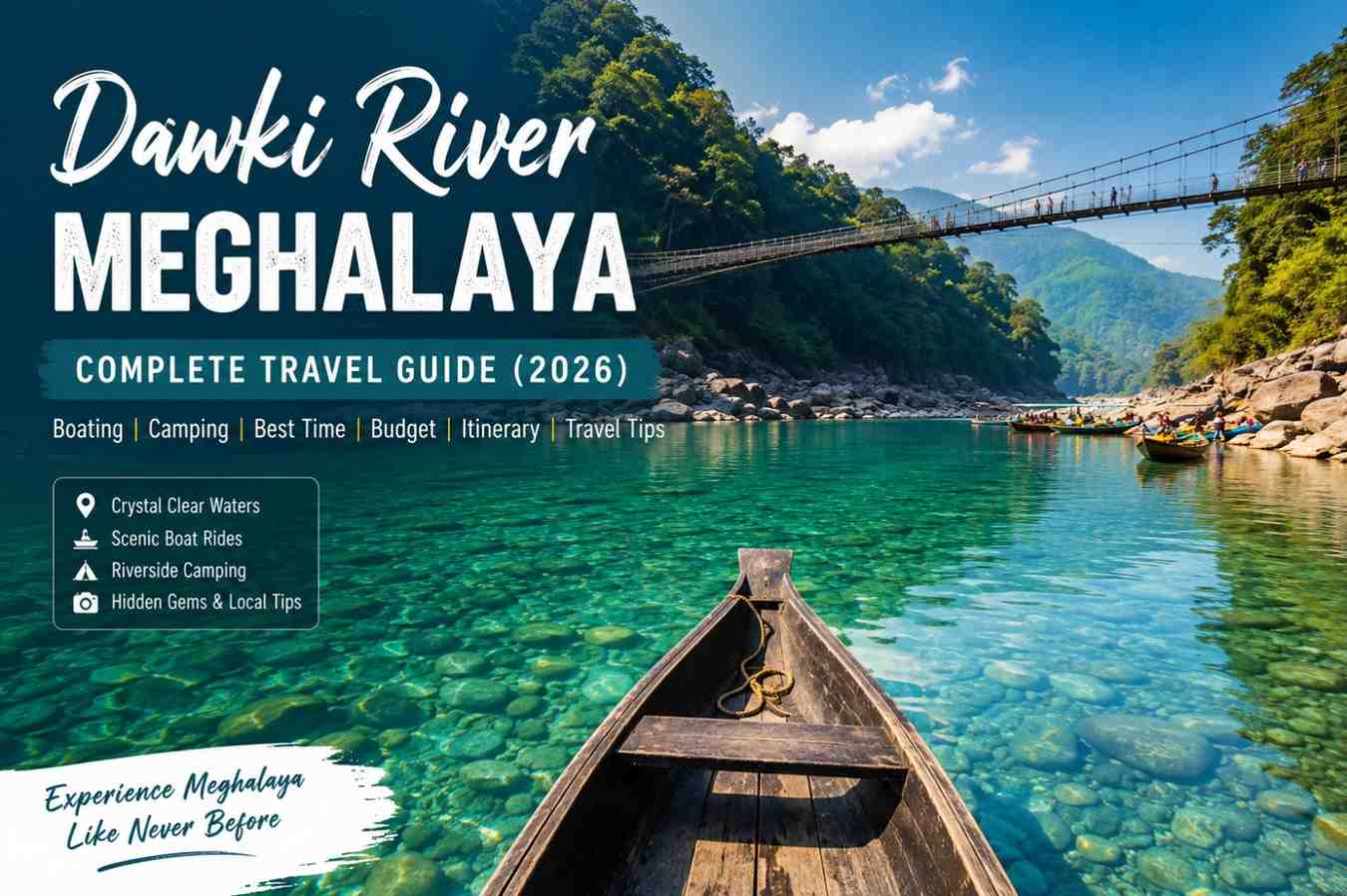
If you've ever come across a photograph of a boat appearing to float in mid-air, there's a good chance it was taken at the Dawki River in Meghalaya.
Over the past few years, Dawki has become one of the most photographed destinations in Northeast India. The crystal-clear waters of the Umngot River, the suspension bridge overlooking the valley, and the peaceful surroundings attract thousands of travellers every year. But despite its growing popularity, many visitors still plan their Dawki trip incorrectly.
In our experience, Dawki is not a destination where you spend an entire day ticking off attractions. Instead, it's a place where you slow down, enjoy the scenery, take a boat ride on one of India's cleanest rivers, and experience a side of Meghalaya that feels untouched.
One mistake we often see is travellers treating Dawki as just a quick stop before heading back to Shillong. While that's possible, spending a night near the river completely changes the experience. Early mornings, before the crowds arrive, reveal the Umngot River at its calmest and clearest.
In this guide, we'll cover everything you need to know before visiting Dawki, including the best time to visit, how to reach, boating costs, weather, road conditions, nearby attractions, accommodation recommendations, and practical tips based on our experience of planning Meghalaya trips.
Whether you're travelling with family, your partner, or a group of friends, this guide will help you plan your visit with realistic expectations rather than social media hype.
Ask anyone who's been to Meghalaya about their favourite place, and Dawki almost always makes the list.
The biggest reason is the Umngot River, often referred to as the Dawki River because it flows beside the town of Dawki. During the winter months, the water becomes so transparent that boats appear to be floating on air.
But Dawki isn't famous only because of its clear water.
The destination combines several experiences in one place:
One of India's cleanest rivers
Scenic boat rides
Adventure activities at Shnongpdeng
The India-Bangladesh border
Riverside camping
Limestone hills and forests
Suspension bridges and panoramic viewpoints
Most of our travellers are surprised by how peaceful Dawki feels despite being one of Meghalaya's most visited destinations.
Unlike crowded hill stations, Dawki still manages to retain its natural charm.
This is one of the most common questions travellers ask.
Technically, the crystal-clear river is called the Umngot River.
Dawki is the small border town through which the river flows.
Over time, because visitors associate the river with the town, people started calling it the "Dawki River."
Both names refer to the same destination, although "Umngot River" is geographically more accurate.
Dawki is located in the West Jaintia Hills district of Meghalaya, close to the India-Bangladesh border.
Distance from major places:
| Destination | Distance | Driving Time |
|---|---|---|
| Shillong | 82 km | 2.5–3 Hours |
| Cherrapunji | 80 km | 2.5–3 Hours |
| Guwahati Airport | 180 km | 5–6 Hours |
| Mawlynnong | 35 km | 1 Hour |
| Shnongpdeng | 8 km | 15–20 Minutes |
Because of its location, Dawki is often combined with nearby destinations such as:
Mawlynnong Village
Shnongpdeng
Riwai Living Root Bridge
We've found that combining these places into one route saves both travel time and transportation costs.
Long before it became a tourist attraction, Dawki was an important trading town between India and Bangladesh.
Even today, you'll find trucks transporting goods across the border every day.
The town continues to play an important role in cross-border trade.
Tourism only gained momentum after photographs of the crystal-clear river started going viral on social media.
Interestingly, the river has remained remarkably clean because of strong community involvement and environmental awareness among local residents.
One thing people usually don't know is that maintaining the cleanliness of the Umngot River is a shared responsibility between local communities and authorities. Visitors are expected to avoid littering, and plastic waste is discouraged around the riverbanks.
Perhaps the most fascinating thing about Dawki is the clarity of its water.
Many travellers assume the river has been artificially cleaned.
That's not true.
The clarity comes from several natural factors:
Unlike muddy rivers, the Umngot flows over stones and rocks rather than loose sediment.
This reduces suspended particles in the water.
The surrounding region has very little industrial development.
This helps preserve the river's natural ecosystem.
The flowing water prevents stagnation and naturally keeps the river clean.
Local residents have played a significant role in protecting the river from pollution.
Based on our Meghalaya trips, travellers are often surprised to see fish swimming beneath the boats because the water is so transparent.
One mistake we often see is people expecting crystal-clear water throughout the year.
That's simply not how nature works.
The appearance of the river changes dramatically with the seasons.
This is undoubtedly the best time to visit Dawki.
The monsoon has ended, water levels become stable, and visibility improves significantly.
Average temperature:
15°C–24°C
Perfect for:
Boating
Camping
Photography
Family trips
Honeymoon couples
This is also when you'll see the famous "floating boat" effect.
A wonderful time for travellers looking to avoid peak-season crowds.
The weather remains pleasant, and the river continues to stay relatively clear.
Warmer temperatures begin to set in, but boating remains enjoyable.
Adventure activities continue to operate.
This season transforms Dawki completely.
Instead of crystal-clear blue water, you'll find a faster-flowing river with reduced visibility due to rainfall.
Boating may be temporarily suspended depending on weather conditions and water levels.
However, the surrounding hills become incredibly lush and green.
In our experience, travellers visiting Meghalaya primarily for waterfalls and landscapes enjoy the monsoon, while those hoping to witness the iconic transparent river are usually happier visiting between October and February.
Yes—but only if your expectations are realistic.
Many social media photos are taken during winter when the water is at its clearest.
During the rainy season:
The river is fuller.
Water clarity reduces.
Adventure activities may depend on weather conditions.
Roads can occasionally be affected by heavy rainfall.
That doesn't mean Dawki loses its charm.
The landscape becomes greener, waterfalls across Meghalaya are at their peak, and the overall drive is incredibly scenic.
We've found that travellers planning a monsoon Meghalaya trip should focus on the experience rather than expecting postcard-perfect photographs.
Technically, yes.
But would we recommend it?
Not always.
Based on our Meghalaya trips, staying overnight—especially in nearby Shnongpdeng—offers a far more relaxed experience.
You'll avoid the busiest hours, enjoy the river in the early morning, and have time for activities like kayaking, camping, or simply sitting by the riverside.
For travellers with limited time, a day trip works.
For anyone wanting to truly experience the destination, an overnight stay is well worth considering.
If you're planning a customized Meghalaya holiday, Dawki is one of the destinations we carefully tailor based on your travel style and the season. Some travellers prefer a scenic day visit, while others enjoy spending a night by the Umngot River to experience its peaceful atmosphere after the crowds leave.
At Take a Break Holidays, we design itineraries around your pace, budget, and interests rather than following fixed schedules—helping you experience Meghalaya in a way that suits your trip best.
While the crystal-clear Umngot River is the biggest attraction, Dawki has much more to offer than just boating.
In our experience, travellers who spend a little extra time here often enjoy the destination far more than those who simply stop for photographs and leave.
Here's everything you can experience around Dawki.
This is undoubtedly the highlight of every Dawki trip.
Gliding over the transparent waters while looking straight down at the riverbed is something that photographs simply can't capture.
Most boats are operated by local boatmen who have been navigating these waters for years. They often know the best spots for photographs and will happily stop at scenic points if requested.
Boat rides generally last between 30 and 60 minutes, depending on the route you choose.
Early morning between 8:00 AM and 10:00 AM usually offers the calmest water and the least crowd.
One mistake we often see is travellers arriving after lunch, especially on weekends. By then, the jetty becomes considerably busier, and you may have to wait for your turn.
Boat charges can change depending on the season and local regulations.
As a general estimate:
| Activity | Approximate Cost |
|---|---|
| Shared Boat | ₹300–₹500 per person |
| Private Boat | ₹800–₹1,500 per boat |
Prices may vary during holidays and peak tourist season.
We always recommend confirming the latest rates before your visit.
Yes.
Boating is generally safe when operated by registered local boat operators.
Life jackets are usually provided and should always be worn, regardless of swimming ability.
During heavy rainfall or when water levels rise significantly, boating operations may be suspended for safety reasons.
If there's one recommendation we make to almost every traveller, it's this:
Don't just visit Dawki. Visit Shnongpdeng as well.
Located just 15–20 minutes from Dawki, Shnongpdeng offers a much quieter riverside experience.
Most of our travellers actually prefer spending the night here instead of Dawki town.
Why?
Because this is where you'll find:
Riverside camps
Adventure activities
Peaceful surroundings
Beautiful sunrise views
Crystal-clear sections of the Umngot River
We've found that Shnongpdeng feels far less commercial and allows travellers to experience Meghalaya at a slower pace.
Camping beside the Umngot River has become one of Meghalaya's most popular experiences.
Imagine waking up beside one of India's cleanest rivers with mist rising over the hills.
Unlike luxury camping destinations, the camps here are simple.
Facilities generally include:
Comfortable tents
Basic washrooms
Campfire areas
Local meals
Riverside seating
One thing people usually don't know is that nights can become surprisingly cool, especially between November and February.
Carrying a light jacket is always advisable.
For travellers looking for a more active experience, kayaking is becoming increasingly popular around Shnongpdeng.
Because parts of the river remain calm during the winter season, beginners can comfortably enjoy kayaking with basic guidance.
Based on our Meghalaya trips, this is one of the most enjoyable activities for couples and small groups.
Adventure lovers can also try cliff jumping at designated locations around Shnongpdeng.
The height varies depending on the chosen spot.
Safety instructions provided by local operators should always be followed.
This activity is usually available only when river conditions are suitable.
Many first-time visitors are surprised to discover that snorkelling is available in parts of the Umngot River.
The remarkable water clarity allows visitors to see fish, rocks, and underwater vegetation.
Availability depends entirely on weather conditions and water visibility.
During recent years, ziplining has become another exciting attraction around Shnongpdeng.
Flying across the river offers an entirely different perspective of the valley.
Adventure operators continue expanding activities in the area, although availability can change seasonally.
This is probably the question we answer most often while planning Meghalaya itineraries.
| Dawki | Shnongpdeng |
|---|---|
| Border town | Riverside village |
| Day visitors | Overnight travellers |
| Limited accommodation | Better camping experience |
| Busy during daytime | Much quieter |
| Close to Bangladesh border | Better for nature lovers |
In our experience:
Visit Dawki during the day.
Stay overnight at Shnongpdeng.
This gives you the best of both places.
Distance:
Approximately 82 km
Driving Time:
Around 2.5–3 hours
The road passes through beautiful valleys and rolling hills.
Most of our travellers stop briefly at viewpoints along the route before continuing towards Dawki.
Distance:
Approximately 80 km
Driving Time:
2.5–3 hours
This route is particularly scenic and often forms part of our Meghalaya circuit.
One mistake we often see is travellers attempting to visit Cherrapunji, Dawki, Mawlynnong, and Shillong all in a single day.
While technically possible, the experience becomes rushed and exhausting.
Instead, we recommend dividing these destinations over multiple days.
Distance:
Around 180 km
Driving Time:
5–6 hours
Driving directly to Dawki after landing is possible but can be tiring.
We've found that spending the first night in Shillong generally makes for a more comfortable itinerary.
Overall, the roads leading to Dawki are in good condition compared to many hill destinations.
However, road conditions can change after prolonged rainfall.
During the monsoon:
Drive carefully around sharp bends.
Expect occasional traffic delays.
Check weather forecasts before travelling.
If you're hiring a private cab, an experienced local driver is highly recommended.
The India-Bangladesh border is located very close to Dawki.
Travellers can visit the border viewpoint and observe cross-border activity.
However:
Crossing into Bangladesh requires valid travel documents and immigration clearance.
Many visitors mistakenly believe they can simply walk across the border.
That's not the case.
While Dawki isn't known for luxury dining, you'll find several small eateries serving fresh local food.
Popular dishes include:
Jadoh (Meghalayan rice and meat dish)
Fried fish
Smoked pork
Chicken curry
Momos
Maggi and tea at riverside cafés
One thing we've found is that riverside cafés often offer simple food but incredible views.
Sometimes the setting becomes more memorable than the meal itself.
Shillong → Dawki → Shnongpdeng → Shillong
Ideal for travellers with limited time.
Shillong → Dawki → Shnongpdeng (Overnight) → Mawlynnong → Shillong
This is one of our favourite combinations because it balances sightseeing with relaxation.
We usually recommend combining:
Shillong
Jowai
Krang Suri Falls
Cherrapunji
Shnongpdeng
Dawki
Mawlynnong
Based on our Meghalaya trips, this route reduces unnecessary backtracking and allows travellers to enjoy each destination at a comfortable pace.
Whether you're looking for a riverside campsite in Shnongpdeng or a comfortable hotel while exploring Dawki, the right itinerary depends on your travel style. Some travellers prefer adventure activities, while others simply want to enjoy a peaceful boat ride and scenic drives.
At Take a Break Holidays, we customize Meghalaya itineraries to match your interests, travel dates, and budget—helping you spend more time enjoying the destination and less time on the road.
One of the most common questions we receive while planning Meghalaya trips is:
"Should we stay in Dawki or return to Shillong?"
The answer depends entirely on the kind of trip you're looking for.
In our experience, travellers who stay overnight near the Umngot River enjoy Dawki much more than those who visit for just a few hours. Early mornings are peaceful, the river is at its clearest, and you don't have to rush back before sunset.
That said, Dawki isn't a destination known for luxury resorts. If you're expecting five-star properties with extensive amenities, you may be disappointed.
Instead, Dawki is about waking up beside one of India's cleanest rivers, listening to birds instead of traffic, and enjoying nature without distractions.
If you're planning to spend the night, we almost always recommend staying in Shnongpdeng instead of Dawki town.
Here's why.
| Dawki | Shnongpdeng |
|---|---|
| Small border town | Riverside village |
| Limited hotel options | Better camps and riverside stays |
| More daytime traffic | Peaceful atmosphere |
| Suitable for quick stopovers | Ideal for overnight stay |
| Few activities after sunset | Campfires, kayaking, riverside walks |
Based on our Meghalaya trips, nearly every traveller who stays in Shnongpdeng tells us they wish they had spent even more time there.
Unlike Shillong or Cherrapunji, accommodation options around Dawki are limited.
However, there are some excellent choices depending on your budget.
Ideal for backpackers and travellers who spend most of their day sightseeing.
Generally expect:
Clean rooms
Attached washrooms
Basic facilities
Parking
Local food
Budget:
₹1,500–₹2,500 per night
Suitable for couples and families looking for comfort.
Usually include:
Spacious rooms
Better bedding
Hot water
Restaurant
Scenic surroundings
Budget:
₹2,500–₹4,500 per night
This is what most people come for.
Sleeping beside the Umngot River offers an experience hotels simply cannot match.
Facilities generally include:
Comfortable tents
Attached or common washrooms
Campfire
Local dinner
Breakfast
Riverside seating
Budget:
₹2,500–₹5,000 per tent
We've found that couples and small groups usually prefer riverside camps over conventional hotels because the experience is far more memorable.
This is where expectations become important.
One mistake we often see is travellers comparing Meghalaya with destinations like Rajasthan or Kerala.
Meghalaya focuses on nature rather than luxury hospitality.
If your priority is five-star hotels, spas, and large resorts, you'll have better options in destinations like Udaipur or Jaipur.
If your priority is waking up beside a crystal-clear river surrounded by forests, Dawki is difficult to beat.
The cost depends on how you're travelling.
Here's a realistic estimate.
| Expense | Approximate Cost |
|---|---|
| Boat Ride | ₹300–₹1,500 |
| Hotel/Camp | ₹2,000–₹5,000 |
| Meals | ₹500–₹1,000 |
| Local Activities | ₹500–₹2,500 |
| Transport (shared) | ₹500–₹1,000 |
| Private Cab (part of Meghalaya itinerary) | Included in package |
For couples visiting Meghalaya as part of a private tour, Dawki is usually included within the overall package cost rather than being priced separately.
This is probably the biggest decision while planning your itinerary.
| One-Day Visit | Overnight Stay |
|---|---|
| Quick sightseeing | Relaxed experience |
| Boat ride | Sunrise on the river |
| Border visit | Camping |
| Photography | Adventure activities |
| Limited time | Leisurely exploration |
If you're travelling for 6–7 days, spend one night in Shnongpdeng.
If your Meghalaya trip is only 4–5 days, a day trip from Shillong or Cherrapunji works well.
After planning hundreds of Meghalaya holidays, we've noticed certain mistakes repeatedly.
The famous photographs are usually taken between October and February.
During the monsoon, the river is still beautiful, but water clarity changes.
Always plan with seasonal expectations.
Many itineraries allow only one hour in Dawki.
By the time you've parked, walked to the river, and waited for boating, your visit is almost over.
We've found that allowing at least three to four hours makes the experience much more enjoyable.
Dawki becomes extremely busy during public holidays.
If possible, plan your visit on weekdays.
Digital payments are accepted at many places today, but network coverage can fluctuate.
Carry some cash for boating, parking, and small eateries.
You'll often walk on rocky surfaces near the river.
Comfortable sports shoes or trekking sandals work much better than slippers.
If you've come to Dawki for photography, timing matters.
8:00 AM–10:00 AM
Morning sunlight enhances the clarity of the water and reduces harsh reflections.
Around noon, sunlight reflects directly off the river, making it harder to capture the famous transparent effect.
Drone regulations may change from time to time.
Always check local permissions before flying.
Even smartphone cameras perform exceptionally well here.
Polarized sunglasses or camera filters can help reduce glare.
Here's what we recommend carrying.
✔ Comfortable walking shoes
✔ Light jacket (October–February)
✔ Sunglasses
✔ Sunscreen
✔ Water bottle
✔ Power bank
✔ Rain jacket (during monsoon)
✔ Waterproof phone pouch
✔ Cash for local payments
✔ Personal medicines
One thing people usually don't know is that mornings near the river can feel much cooler than Shillong during winter.
| Season | Experience | Recommended? |
|---|---|---|
| Winter (Oct–Feb) | Crystal-clear water | ⭐⭐⭐⭐⭐ |
| Spring (Mar–Apr) | Pleasant weather | ⭐⭐⭐⭐☆ |
| Summer (May) | Warm but enjoyable | ⭐⭐⭐⭐☆ |
| Monsoon (Jun–Sep) | Green landscapes, stronger river | ⭐⭐⭐☆☆ |
Based on our Meghalaya trips, here are a few practical ways to reduce costs without compromising your experience.
Travel on weekdays to avoid peak-season pricing.
Stay in Shnongpdeng instead of driving back to Shillong.
Combine Dawki with Mawlynnong in the same day.
Book your Meghalaya cab for the entire trip instead of hiring local taxis at each destination.
Travel as a group if possible, since cab costs are shared.
Reserve accommodation in advance during October, November, and December.
Most tourists visit Dawki and leave.
However, the surrounding region has several lesser-known places worth exploring.
A peaceful waterfall surrounded by forests.
Ideal for travellers who enjoy quieter locations.
Smaller than the famous Double Decker Root Bridge but much easier to access.
Perfect when combined with Mawlynnong.
Often referred to as one of Asia's cleanest villages.
Known for bamboo walkways, flower-lined streets, and community-led tourism.
Watching daily cross-border trade offers a unique perspective on the importance of Dawki beyond tourism.
In our experience, Dawki is best enjoyed as part of a well-planned Meghalaya circuit rather than as a rushed standalone stop. The order in which you visit Shillong, Cherrapunji, Dawki, Shnongpdeng, and Mawlynnong can significantly reduce travel time and make the journey far more enjoyable.
At Take a Break Holidays, we create customized Meghalaya itineraries based on your travel dates, group size, and preferred pace, ensuring you spend less time on the road and more time experiencing what makes Meghalaya special.
Dawki is famous for the crystal-clear waters of the Umngot River. During winter, the water becomes so transparent that boats appear to float in mid-air, making it one of the most photographed destinations in Meghalaya.
The best time to visit Dawki is between October and February when the water is at its clearest and the weather is pleasant.
Yes, but for different reasons.
During the monsoon, waterfalls are spectacular and the landscape becomes lush green. However, the river won't have the famous crystal-clear appearance that most travellers expect.
For a comfortable visit, keep at least 3–4 hours. If you're planning boating, photography, and exploring nearby Shnongpdeng, an overnight stay is highly recommended.
Swimming is possible only in designated areas where local operators permit it. Always follow local safety instructions and avoid entering the river without guidance.
Mostly yes.
However, boating may be temporarily suspended during heavy rainfall or when water levels become unsafe.
Boat charges generally range between ₹300 and ₹1,500 depending on whether you choose a shared or private boat.
Absolutely.
Based on our Meghalaya trips, Dawki is one of the most family-friendly destinations in the state.
Yes.
The area is generally considered safe, although it's always advisable to avoid isolated areas after dark and follow local guidelines.
Definitely.
Couples particularly enjoy riverside camps, peaceful boat rides, and the scenic surroundings.
Yes.
This is one of the most popular day combinations in Meghalaya.
If your itinerary allows, stay one night in Shnongpdeng near Dawki for a more relaxed experience.
Otherwise, Shillong works well as a base.
There are limited banking facilities.
Carry sufficient cash, especially if you're staying in riverside camps.
Yes, although network strength varies depending on the service provider and exact location.
Drone regulations change periodically.
Always check current permissions and respect local restrictions.
Approximately 82 km, which takes around 2.5 to 3 hours by road.
Yes, but if you want to experience camping, kayaking, sunrise, and the peaceful side of the river, stay overnight.
Visit Dawki.
Stay in Shnongpdeng.
This is the combination we recommend to most travellers.
Not particularly.
Accommodation and activities are reasonably priced compared to many popular tourist destinations.
Yes.
The boating experience is comfortable, and most attractions don't require strenuous walking.
The Dawki River isn't just another sightseeing stop in Meghalaya—it's one of those places where slowing down is part of the experience.
In our experience, the travellers who enjoy Dawki the most aren't the ones rushing through a packed itinerary. They're the ones who arrive early, spend time by the river, take a leisurely boat ride, enjoy a local meal, and let the destination unfold at its own pace.
One mistake we often see is trying to cover Shillong, Cherrapunji, Mawlynnong, and Dawki in a single day. While it may look manageable on Google Maps, hill roads, scenic stops, and changing weather make such plans tiring and rushed.
We've found that a well-planned itinerary always creates a better travel experience than trying to tick every destination off a list.
Whether you're travelling with your family, your partner, or a group of friends, Dawki deserves more than just a quick photo stop. It's a place to pause, appreciate nature, and experience one of Meghalaya's most remarkable landscapes.
If you're planning a Meghalaya holiday and want an itinerary that balances sightseeing with comfort, we'd be happy to help.
At Take a Break Holidays, we specialize in customized private Meghalaya tours designed around your travel style—not fixed, one-size-fits-all packages. Whether you're looking for a honeymoon, family vacation, or an offbeat adventure, we'll help you create an itinerary that makes the most of your time in the state.
Explore more Meghalaya travel guides on our website to help you plan your journey better.
Naturally link this article to your existing blogs:
Meghalaya Trip
Meghalaya Offbeat Itinerary
Best Meghalaya Itinerary for Families
Meghalaya Trip Cost
Dawki vs Shnongpdeng
Cherrapunji Travel Guide
Double Decker Living Root Bridge Trek Guide
Shillong Travel Guide
Best Time to Visit Meghalaya
Include these as structured data for SEO:
What is Dawki River famous for?
Is Dawki River worth visiting?
What is the best time to visit Dawki?
How much does boating cost in Dawki?
Can you swim in Dawki River?
Where should I stay in Dawki?
Is Dawki good for families?
Is Shnongpdeng better than Dawki?
How far is Dawki from Shillong?
Can Dawki be covered in one day?

Explore our highly-rated tour packages and start planning your next adventure.
View Tours Chat Now